What Do Impersonation Scams Look Like Around the World?

AI-generated deepfake voice cloning has quickly emerged as a common tactic by fraudsters, which has made mitigating robocalling fraud significantly more complex for mobile operators.
Impersonation robocall scams are already common across regions, but AI-generated deepfake robocalls are becoming more convincing as fraudsters increasingly use advanced AI-tools to generate natural synthetic voices.
Operators must ensure they offer advanced fraud prevention solutions and measures to provide them with the strongest levels of protection against AI-generated robocalling fraud.
Advanced solutions are more capable of disrupting fraud earlier in the attack chain; recognising voice cloning, keeping up with fraudsters’ evolving tactics, and identifying omnichannel attacks. Implementing these will help transition operators from reactively mitigating robocalling fraud to actively mitigating it in real time; making them particularly well-suited to combatting fraud using advanced AI techniques.
About the Infographic
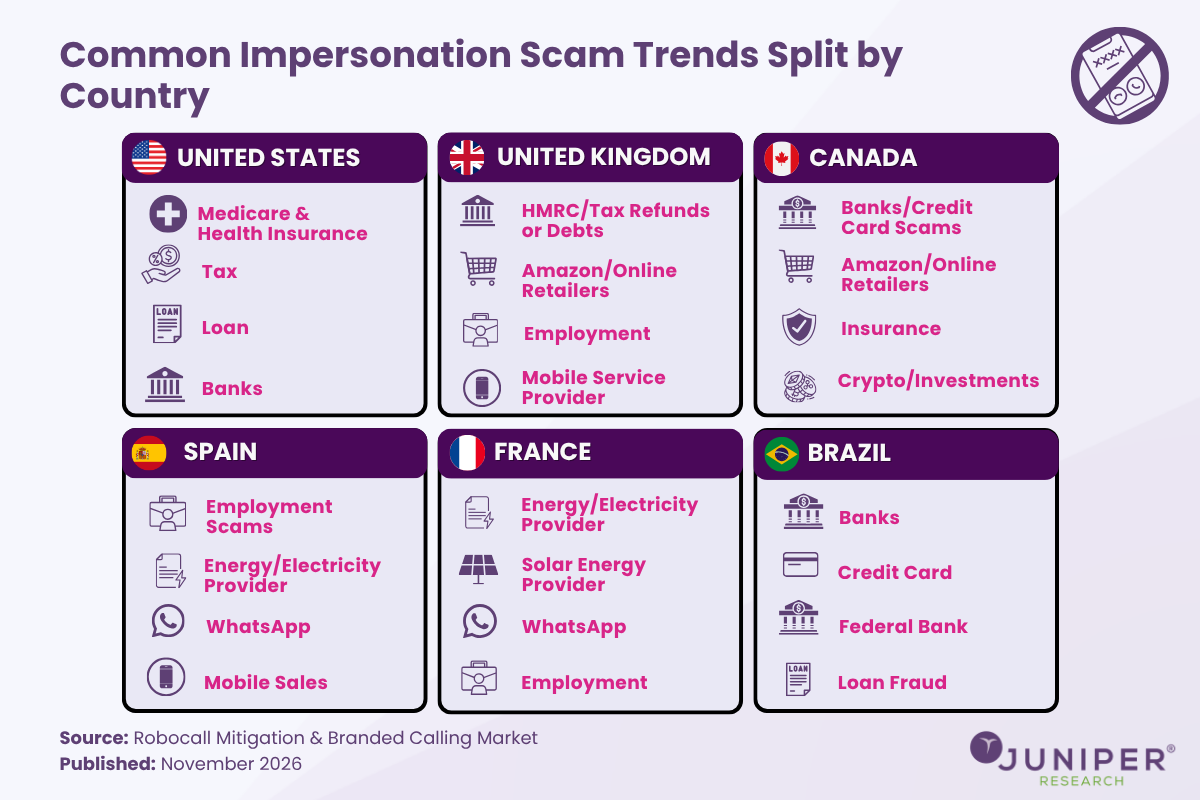
The infographic sheds light on common impersonation scam trends across six countries; demonstrating how fraudsters exploit familiar organisations, services and financial institutions to deceive individuals. While the nature of these scams varies by market, several recurring themes emerge, particularly around financial services, employment, online retail, and utility providers.
In the United States, impersonation scams frequently target individuals through fraudulent communications claiming to represent Medicare and health insurance providers. Other commonly impersonated organisations include tax authorities, banks, and loan providers. These scams exploit concerns around healthcare coverage, financial obligations, and access to banking services.
In the United Kingdom, scammers commonly impersonate HMRC; using fraudulent messages about tax refunds or outstanding tax debts to gain victims' attention. Online retailers, particularly Amazon, are also frequently targeted, alongside employment organisations and mobile service providers. These approaches often rely on familiar brands and services to establish credibility.
In Canada, financial institutions remain a prominent target, with banks and credit card providers frequently impersonated in fraudulent communications. Online retailers, particularly Amazon, are another major focus area. The infographic also identifies insurance providers and cryptocurrency or investment services as areas where impersonation scams are prevalent.
In Spain, employment-related scams feature prominently, alongside fraudulent communications impersonating energy and electricity providers. WhatsApp is another commonly exploited platform, while mobile sales-related scams are also a common feature. This indicates the use of both established service providers and widely used digital communication channels to target consumers.
In France, energy and electricity providers are among the most frequently impersonated organisations, and solar energy providers are also a notable target. Scammers additionally exploit WhatsApp and employment-related opportunities to deceive individuals. The presence of energy-related scams across both conventional and renewable energy providers highlights the breadth of organisations being impersonated.
In Brazil, financial services are a particularly prominent target for impersonation fraud. Banks and credit card providers feature among the commonly impersonated institutions, with the Federal Bank also identified as a specific target. Loan fraud is another notable category; suggesting that scammers frequently exploit consumers' interactions with financial institutions and lending services.
Source: Robocalling & Branded Calling Market: 2026-2031
Read the Press Release: North American Consumer Losses from Fraudulent Robocalls to Fall by a Third by 2031; Driven by Robust Solutions and Branded Calling
Download the Whitepaper: Deepfakes in Robocalling Fraud – the Need for Advanced Solutions and Frameworks in 2027 and Beyond
Latest research, whitepapers & press releases
-
 ReportNovember 2026Fintech & Payments
 Lorien Carter
Virtual Cards Market: 2026-2031
Our Virtual Cards research suite provides a comprehensive and in-depth analysis of the role of virtual cards in the digital payments landscape
VIEW -
 ReportNovember 2026Fintech & Payments
 Shane O'Sullivan
B2B Payments Market: 2026-2031
Our B2B Payments research suite provides a wide-ranging and rigorous analysis of this massive market; enabling stakeholders from B2B payment platform providers to regulators and banks, to understand future growth, key trends and the competitive environment.
VIEW -
 ReportNovember 2026Telecoms & Connectivity
 Ardit Ballhysa
Robocalling & Branded Calling Market: 2026-2031
Our Robocalling & Branded Calling Market research suite provides insightful analysis of a market that is becoming increasingly dynamic and complex.
VIEW -
 ReportNovember 2026Telecoms & Connectivity
 Peter Boyland
CPaaS Market: 2026-2031
Our CPaaS Market 2026-2031 research suite delivers insightful analysis of a market that will experience significant growth in the next five years. It provides an analysis of CPaaS vendors, key partnerships and client relationships, alongside intelligence on how to capitalise on changing market dynamics within the rapidly expanding CPaaS market.
VIEW -
 ReportOctober 2026Fintech & Payments
 Michael Greenwood
Accounts Payable Automation Market: 2026-2031
Our Accounts Payable (AP) Automation research suite provides an insightful analysis of this rapidly growing market; enabling stakeholders to understand future growth, key trends and the competitive environment.
VIEW -
 ReportOctober 2026Fintech & Payments
 Jawad Jahan
Crypto-gaming Market: 2026-2035
Our Crypto-gaming Market research suite provides an insightful analysis of this rapidly growing market; enabling stakeholders - from crypto-gaming and sportsbooks operators, prediction market platforms, business-to-business (B2B) gambling platforms and software providers, to crypto payment processors and regulators - to understand future growth, key trends, and the competitive environment.
VIEW


-
 WhitepaperNovember 2026Fintech & Payments
Lorien Carter
Is Agentic Commerce on the (Virtual) Cards?
Our complimentary whitepaper, Is Agentic Commerce on the (Virtual) Cards?, examines the state of the virtual cards market; explaining the role of key actors in the virtual cards landscape and recent developments within the virtual cards industry.
VIEW -
 WhitepaperNovember 2026Fintech & Payments
Shane O'Sullivan
The End of Wire Transfer – the Battle for B2B Payments
Our complimentary whitepaper, The End of Wire Transfer – the Battle for B2B Payments, examines the rapidly evolving state of the B2B payments market.
VIEW -
 WhitepaperNovember 2026Telecoms & Connectivity
Ardit Ballhysa
Deepfakes in Robocalling Fraud – the Need for Advanced Solutions and Frameworks in 2027 and Beyond
Our complimentary whitepaper, Deepfakes in Robocalling Fraud – the Need for Advanced Solutions and Frameworks in 2027 and Beyond, explores the challenges and opportunities for fraud prevention.
VIEW -
 WhitepaperNovember 2026Telecoms & Connectivity
Peter Boyland
Rich Messaging, Real Growth: the Rise of RCS and OTT in CPaaS
Our complimentary whitepaper, Rich Messaging, Real Growth: the Rise of RCS and OTT in CPaaS, explores the challenges and opportunities for operators and enterprises as CPaaS becomes more embedded in the consumer experience.
VIEW -
 WhitepaperOctober 2026Fintech & Payments
Michael Greenwood
Accounts Payable Automation ~ How Businesses Are Reducing Operational Costs
Our complimentary whitepaper, Accounts Payable Automation ~ How Businesses Are Reducing Operational Costs, analyses how AP automation is combatting costs by decreasing the need for manual processes, and provides strategic insight into a number of key trends in the AP automation space.
VIEW -
 WhitepaperOctober 2026Fintech & Payments
Jawad Jahan
Compliance or Anonymity - The Crypto-gaming Operator’s Dilemma
Our complimentary whitepaper, Compliance or Anonymity - The Crypto-gaming Operator’s Dilemma, analyses the current regulatory landscape of the crypto-gaming market.
VIEW


-
Fintech & Payments
Virtual Cards Market Leaders Revealed by Juniper Research, as Revenue Forecast to Hit $148 Billion by 2031
November 2026 -
Fintech & Payments
B2B Payment Transactions to Exceed 612 Billion by 2031, as Fintechs Challenge Banks for Business Payment Relationships
November 2026 -
Fintech & Payments
27th NextGen Payments & RegTech Forum Returns to Limassol, Cyprus
November 2026 -
Telecoms & Connectivity
North American Consumer Losses from Fraudulent Robocalls to Fall by a Third by 2031; Driven by Robust Solutions and Branded Calling
November 2026 -
Telecoms & Connectivity
CPaaS Market Value to Exceed $50 Billion Globally by 2031, as Infobip, Twilio, and Sinch Identified as Market Leaders
November 2026 -
Fintech & Payments
26th NextGen Payments & RegTech Forum Arrives in Austin, Texas
October 2026