Which API Type Is Leading the Charge in Operator Revenue from Network APIs?

Network APIs in telecommunications are not a new development. They are software interfaces that allow developers to integrate network capabilities and services provided by telecommunications operators into their applications. Network APIs enable applications and IT systems to access, consume or, in some cases, configure selected network functions - such as device location, number verification, SIM-swap checks, quality-of-service controls and edge services - in a secure and controlled manner.
Sometimes developers and enterprises are still unfamiliar with which APIs are being provided, how they can be used, how they can be accessed, and where they can be accessed. As a result, operators need to focus on educating enterprises and developers. They must invest in providing documentation, webinars and events that engage and educate developers and enterprises, and thus promote the adoption of network APIs.
Juniper Research believes operators need to promote models and tools that allow operators to establish the value of their network APIs in the minds of developers and enterprises, which can then be scaled into a large revenue stream. This will allow operators to build the market for network APIs more quickly, and maximise their value, rather than stifling growth by trying to charge a premium early on. Operators must behave like startups: concentrating on building demand and users rather than revenue.
Juniper Research also notes that many operator deployments of network APIs are in their early stages, and not yet ready to scale for significant growth. This can also be said for distribution channels in the market, which may not yet be ready to scale large enough for network APIs to generate significant revenue. As the infrastructure behind network APIs becomes more established, operators will be able to quickly scale their revenue from them.
About the Infographic
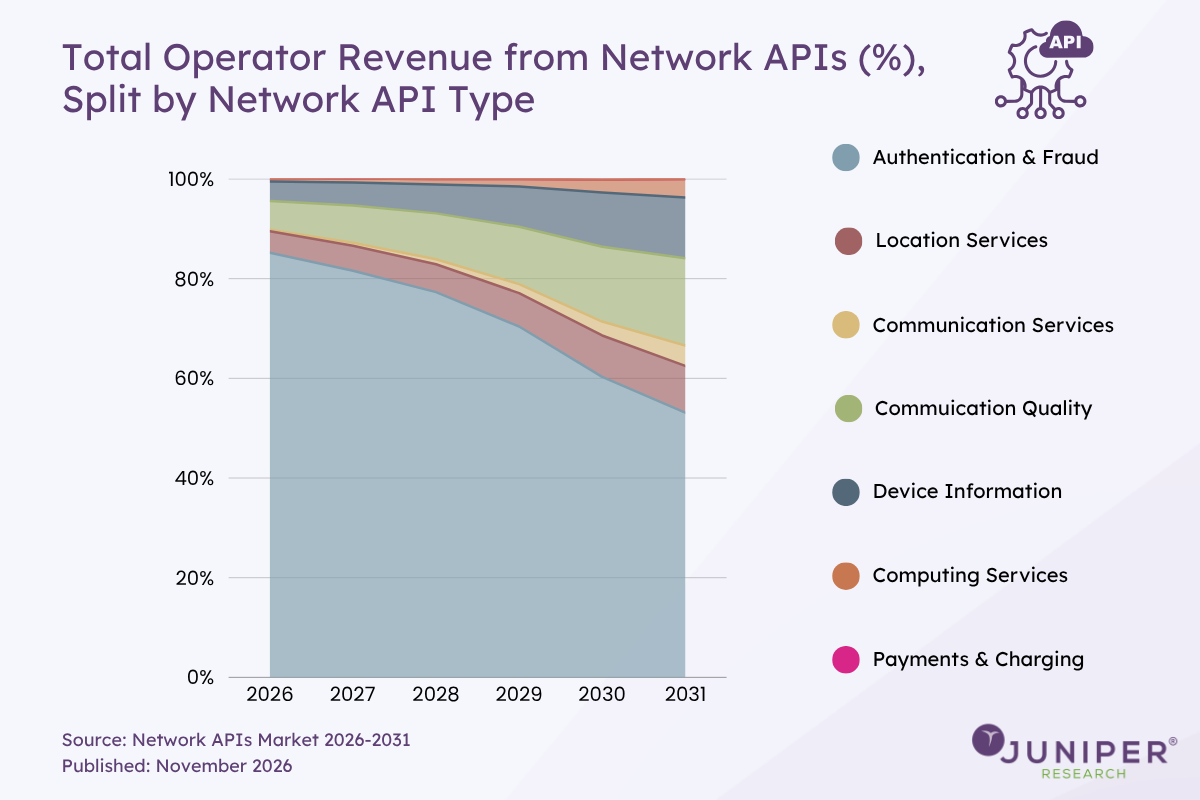
The graph represents the projected distribution of operator revenue from network APIs by API type between 2026 and 2031.
Authentication and fraud APIs are expected to account for the largest share of operator revenue in 2026. However, their contribution is forecast to decline considerably over the period; falling from approximately 83% in 2026 to around 55% by 2031. This suggests that although authentication and fraud prevention remain important applications of network APIs, revenue generation is expected to become more diversified as other API categories gain traction.
In contrast, device information APIs and communication quality APIs are projected to increase their respective shares of total operator revenue. The former are expected to record notable growth towards the end of the forecast period; reaching approximately 13% by 2031. Whilst the latter are also anticipated to gain a larger share; reflecting growing demand for network performance insights and capabilities that enable businesses to optimise connectivity and service delivery.
Location services APIs are expected to maintain a relatively modest contribution, whilst communication services APIs will account for a smaller proportion of overall revenue.
Meanwhile, computing services, and payments and charging APIs are projected to contribute comparatively smaller shares of operator revenue throughout the forecast period.
Overall, the changing revenue distribution highlights a gradual diversification of the network APIs market. While authentication and fraud APIs are expected to remain a significant revenue contributor, the growing shares of device information APIs and communication quality APIs indicate expanding opportunities for operators to monetise a broader range of network capabilities.
Source: Network APIs Market: 2026-2031
Read the Press Release: Fraud & Authentication Network API Revenue to Pass $6 Billion Globally by 2031, Thanks to New KYC Opportunities
Download the Whitepaper: How Operators Can Monetise Network APIs without Compromising Trust
Latest research, whitepapers & press releases
-
 ReportDecember 2026Telecoms & Connectivity
 Fred Savage
Operator Revenue Strategies Market: 2026-2031
Discover invaluable insights into trends and strategies for network operator revenue in our latest report, Network Operator Revenue Strategies. With data split across 60 countries, this extensive forecast analyses the dynamic and competitive network operator market and the current market challenges posed by slowing revenue, high market saturation in the consumer market, rising network ownership costs, and challenges in 5G monetisation.
VIEW -
 ReportDecember 2026Fintech & Payments
 Dr Manju Chhillar
eCommerce Payments Market: 2026-2031
Our eCommerce Payments Market 2026-2031 report offers an in-depth assessment of this fast-changing market. It provides stakeholders - from eCommerce payment platform providers to merchants and payment service providers - the insight they need to anticipate growth, respond to emerging trends, and benchmark themselves against the competition.
VIEW -
 ReportNovember 2026Telecoms & Connectivity
 Thomas Wilson
Network APIs Market: 2026-2031
Our Network APIs Market research suite provides operators, Communications Platform-as-a-Service (CPaaS) providers, and other GSMA channel partners with extensive analysis and actionable insights into the rapidly growing network API market.
VIEW -
 ReportNovember 2026Fintech & Payments
 Lorien Carter
Virtual Cards Market: 2026-2031
Our Virtual Cards research suite provides a comprehensive and in-depth analysis of the role of virtual cards in the digital payments landscape
VIEW -
 ReportNovember 2026Fintech & Payments
 Shane O'Sullivan
B2B Payments Market: 2026-2031
Our B2B Payments research suite provides a wide-ranging and rigorous analysis of this massive market; enabling stakeholders from B2B payment platform providers to regulators and banks, to understand future growth, key trends and the competitive environment.
VIEW -
 ReportNovember 2026Telecoms & Connectivity
 Ardit Ballhysa
Robocalling & Branded Calling Market: 2026-2031
Our Robocalling & Branded Calling Market research suite provides insightful analysis of a market that is becoming increasingly dynamic and complex.
VIEW


-
 WhitepaperDecember 2026Fintech & Payments
Dr Manju Chhillar
Beyond the Card: the Changing Payment Mix in Global eCommerce
Our complimentary whitepaper, Beyond the Card: the Changing Payment Mix in Global eCommerce, examines the alternative payment methods which are challenging the dominance of cards in online commerce.
VIEW -
 WhitepaperNovember 2026Telecoms & Connectivity
Thomas Wilson
How Operators Can Monetise Network APIs without Compromising Trust
Our complimentary whitepaper, How Operators Can Monetise Network APIs without Compromising Trust, explores how operators can capitalise on the opportunities in the network API market, both now and in the future.
VIEW -
 WhitepaperNovember 2026Fintech & Payments
Lorien Carter
Is Agentic Commerce on the (Virtual) Cards?
Our complimentary whitepaper, Is Agentic Commerce on the (Virtual) Cards?, examines the state of the virtual cards market; explaining the role of key actors in the virtual cards landscape and recent developments within the virtual cards industry.
VIEW -
 WhitepaperNovember 2026Fintech & Payments
Shane O'Sullivan
The End of Wire Transfer – the Battle for B2B Payments
Our complimentary whitepaper, The End of Wire Transfer – the Battle for B2B Payments, examines the rapidly evolving state of the B2B payments market.
VIEW -
 WhitepaperNovember 2026Telecoms & Connectivity
Ardit Ballhysa
Deepfakes in Robocalling Fraud – the Need for Advanced Solutions and Frameworks in 2027 and Beyond
Our complimentary whitepaper, Deepfakes in Robocalling Fraud – the Need for Advanced Solutions and Frameworks in 2027 and Beyond, explores the challenges and opportunities for fraud prevention.
VIEW -
 WhitepaperNovember 2026Telecoms & Connectivity
 Peter Boyland
Rich Messaging, Real Growth: the Rise of RCS and OTT in CPaaS
Our complimentary whitepaper, Rich Messaging, Real Growth: the Rise of RCS and OTT in CPaaS, explores the challenges and opportunities for operators and enterprises as CPaaS becomes more embedded in the consumer experience.
VIEW


-
Telecoms & Connectivity
Fraud & Authentication Network API Revenue to Pass $6 Billion Globally by 2031, Thanks to New KYC Opportunities
November 2026 -
Telecoms & Connectivity
Private Networks in Service to Exceed 47,000 Globally by 2031, as Industry Specialisation & 5G Drive Expands
November 2026 -
Fintech & Payments
Virtual Cards Market Leaders Revealed by Juniper Research, as Revenue Forecast to Hit $148 Billion by 2031
November 2026 -
Fintech & Payments
B2B Payment Transactions to Exceed 612 Billion by 2031, as Fintechs Challenge Banks for Business Payment Relationships
November 2026 -
Fintech & Payments
27th NextGen Payments & RegTech Forum Returns to Limassol, Cyprus
November 2026 -
Telecoms & Connectivity
North American Consumer Losses from Fraudulent Robocalls to Fall by a Third by 2031; Driven by Robust Solutions and Branded Calling
November 2026